Who is Wu Zhenzhou?
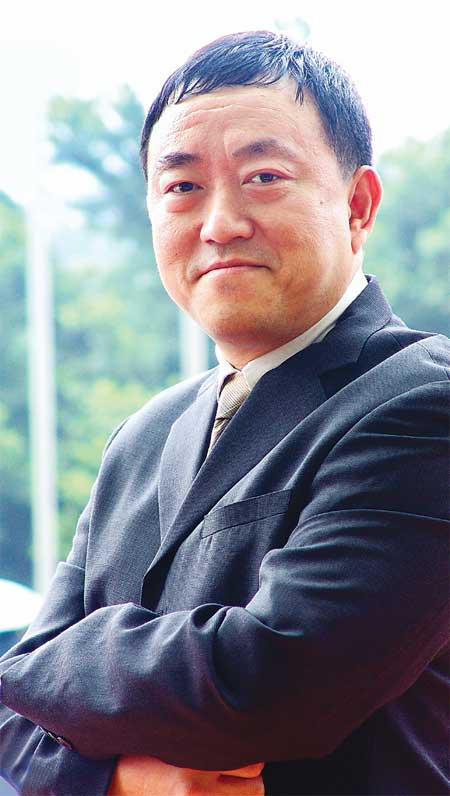
Born in Jiangxi Province, 46-year-old Wu suffered hardship in his early years. His parents divorced during the Cultural Revolution (1966-76) and he was forced to separate from his father who was branded an "intellectual" and sent to farms for re-education and forced to wear a dunce hat while being ridiculed by farmers.
After 1977, he was able to finish high school and went to college. He received his first degree in mathematics and taught math and English at a local middle school in Jiangxi. In 1986, he studied sociology at Nankai University in Tianjin and was assigned to work at a research institute under the Ministry of Civil Affairs.
Wu left China in 1991 for a postgraduate programme in Chinese history at Harvard. In 1995, Wu returned to China to set up Shenzhen Chitron.After a decade of growth, it became one of the top 10 electronic component distributors, with an annual revenue of about $25 million.
By Song Shengxia
The proud Harvard graduate was once a respected CEO of one of China's top 10 independent electronic component distributors in Shenzhen, Guangdong Province.
Now Wu Zhenzhou sits in a 6-square-meter cell in a US detention center facing a possible 20-year sentence for conspiracy to violate US export laws and illegally exporting electronic equipment from the US to China between 2004 and 2007. He will be sentenced August 17.
Branded a "Chinese spy" by the American media, his was one of the most high-profile US counterintelligence cases in 2009.
Some 50 FBI officers were involved in the arrest of the three Chinese defendants - originally indicted on 38 counts, including conspiracy to violate the US Arms Export Control Act for allegedly exporting defense weapons and electronics, money laundering and filing false documents with the US Department of Commerce.
During his six-week trial in Boston, the Global Times interviewed Wu. Sitting behind a glass screen in the visitors' room of the Wyatt Detention Facility (WDF) in Rhode Island near Boston, Wu wore an ill-fitting gray prison uniform and a blue wrist tag to indicate that he is non-violent.
Wu, the founder of Shenzhen Chitron Electronics, said he still couldn't believe all that happened to him over the past 500 days.
"It's a nightmare, an American nightmare. What I've learned about US democracy and rule by law is a far cry from what I'm experiencing now," Wu said from the phone hanging on the wall.
"The reason I'm here is that the US government fears China catching up in high-tech," he said.
'No deal'
Wu was arrested on December 5, 2008 at Chicago airport. On the same day, Wu's ex-wife Wei Yufeng, an accountant at Chitron-US and company manager Li Bo were also arrested. The FBI raided the office of Chitron-US owned by Wu and took away 12 boxes of documents and goods awaiting shipment, and copied all the data from the company's computers and servers.
Wu and Wei, both 46, Shenzhen Chitron Electronics and Chitron-US were all charged on 32 counts.
After a month in detention in Chicago, pending trial, he was transferred to WDF, which has over 600 detainees.
Visitors are allowed three times a week for an hour. In the large visitors' room, detainees were talking over phone to visiting families and friends but, for some reason, they needed to shout to get across.
Liu Luxin, Wu's former classmate who came from Australia to visit him, pressed his right hand on the thick glass - while Wu pressed his on the other side - to greet each other.
"If you really did what they alleged, we can enter a deal with the prosecutors through your lawyer for lighter punishment," Liu said.
"I have done nothing wrong. Why should I enter a deal?" Wu said.
According to Wu, 95 percent of those in WDF have pleaded guilty and agreed to "cooperate with the US government". Such plea deals earn them a lighter penalty if convicted.
"But I don't want to bend under intimidation. If I'm convicted, much material concerning my case released later will serve as the best evidence to show how dark the US administrative and legal system can be," he said days before his guilty verdict was delivered.
He said he would fight to the end because he claimed he was ignorant of the controlled parts and US export control regulations. His appeal might take a year or so.
However, the prosecutors believed that the defendants had conspired to illegally export electronic equipment from the US to China through Hong Kong between 2004 and 2006.
The exported equipment is used in electronic warfare, military radar, fire control, military guidance and control equipment and satellite communications, including global positioning systems, the prosecutor said. They also believed that several Chinese military entities including Shanghai Academy of Spaceflight Technology were among those receiving the equipment.
In an article by the US-based Defense News owned by the Army Times at the time when the defendants were indicted, it said "the indictment of three Chinese nationals for alleged export violations of defense articles highlights China's aggressive industrial spying campaign that vacuums up advanced US technology secret and the vague, ineffective nature of US control efforts.
"China is clearly engaged in a massive campaign of industrial espionage aimed at stealing American technology and intellectual property," Loren Thompson of the Lexington Institute was quoted by the Defense News as saying.
Ignorant or willful?
Wu's case is all about proving whether Wu exported the goods "knowingly" and "willfully" or out of "ignorance" and by "mistake".
According to Wu, the prosecutors had exhausted all means to make him plead guilty, including putting him in a suicide watch room with a dazzling light turned on for 24 hours after his trial started until his defense attorney requested the case judge to release him from the room.
To convince the jury of 12, chosen from Boston residents with no Asia-Americans, prosecutors showed them colorful pictures of military weapons suggesting that the components exported were for military use.
The defense lawyers showed that the components also had commercial, non-military uses; and, that the Shanghai Academy of Spaceflight Technology was not Chitron's end user.
Donald K Stern, Wu's lawyer, said Wu was targeted in "the strangest conspiracy." Steve Gigliotti, a former Shenzhen Chitron employee and later Chitron-US manager for five years, reported Wu to the US government after he had a disagreement with Wu and left the company in 2007.
Stern says Gigliotti struck a deal with the FBI to become a cooperating witness to testify against Wu and escape prosecution because many of Chitron-US' shipping documents were signed by Gigliotti.
"The US government adopts double standards in economic cases. If Wu was an American, he will be let off with fines for his ignorance instead of being tried as a criminal," Shi Huaifang, a Shenzhen lawyer of Wu's defense team said.
A US lawyer, who attended the trial, on condition of anonymity, said that the case also highlighted "xenophobia" and "racism" prevalent in US agencies. "All the individual defendants are Chinese and the individuals who are US citizens and actually arranged for the allegedly unlawful exports either received immunity or have yet to be charged (and probably will not be)."
Vague US export laws
However, even Gigliotti admitted in court that he himself was not familiar with US export regulations before 2007, when the Export Administration Act was amended to include a list of "sensitive dual-use items that could be used for China's militarization."
Federal District Judge Patti Sari said this was the most complicated case in her 20 years.
"The export control laws are indeed a trap for the unwary, and they are exceedingly vague…These laws and regulations are a trap that can be sprung, by the federal prosecutors, on anyone they target," Harvey Silverglate, a renowned lawyer in Boston and author of Three Felonies a Day wrote in an email to the Global Times.
In June 2009, the US Court of Appeals for the Seventh Circuit overturned the conviction of Doli Syarief Pulungan, who had been found guilty of exporting rifle scopes in violation of the International Traffic in Arms Regulations. In its ruling, the court said that the government had failed to properly identify which items are subject to export control regulations, or to justify the criteria for controlling them.
"A regulation is published for all to see," said Judge Frank H Easterbrook of the Appeals Court."People can adjust their conduct to avoid liability. [In contrast,] a designation by an unnamed official, using unspecified criteria, that is put in a desk drawer, taken out only for use at a criminal trial, and immune from any evaluation by the judiciary, is the sort of tactic usually associated with totalitarian regimes," he said.
'Chinese tech spying'
In recent years, the US stepped up its offensive against what it calls "Chinese tech spying." The FBI increased the number of counter-espionage agents from 150 in 2001 to more than 350 in 2007, a report by the USA Today said.
On May 12, five days before Wu's conviction, Chi Tong Kuok, from Macao, was convicted on four counts for attempting to have the equipment sent to Macao and Hong Kong. The equipment included communications, encryption, and GPS equipment used by the US and NATO forces, prosecutors said.
Wang Baodong, a spokesman for the Chinese Embassy in Washington, said the allegations of China conducting spying activities against the US are groundless and unwarranted.
Fighting with his pen
According to the US Attorney General's Office, sentencing is set for August 17. Both Wu and Wei could face up to 20 years in prison and a fine of $1 million. Chitron-US, now closed, could be fined up to $1 million. The operations of Chitron Shenzhen remain largely unaffected.
Li, who previously pleaded guilty to making false statements about shipping documents, could face five years imprisonment followed by three years of supervised release and a fine of $1 million. Sentencing is set for July 22.
The court later allowed Wei to remain on bail but ordered her to post her home as bond, and that she be under 24-hour home surveilence.
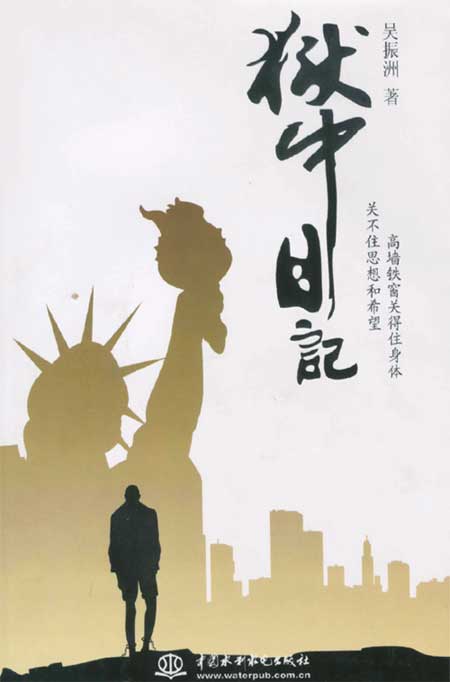
On May 23, Wu's computer, with which he has studied his case documents and wrote his personal blog called Diary in Jail, was taken away.
In the visitors' room, Wu said he had nothing to fear as he experienced his darkest days in detention.
"If I'm held guilty and jailed, I will fight with my pen by writing my stories here," he said.
|